Buying a freight forwarder: what to check before you sign
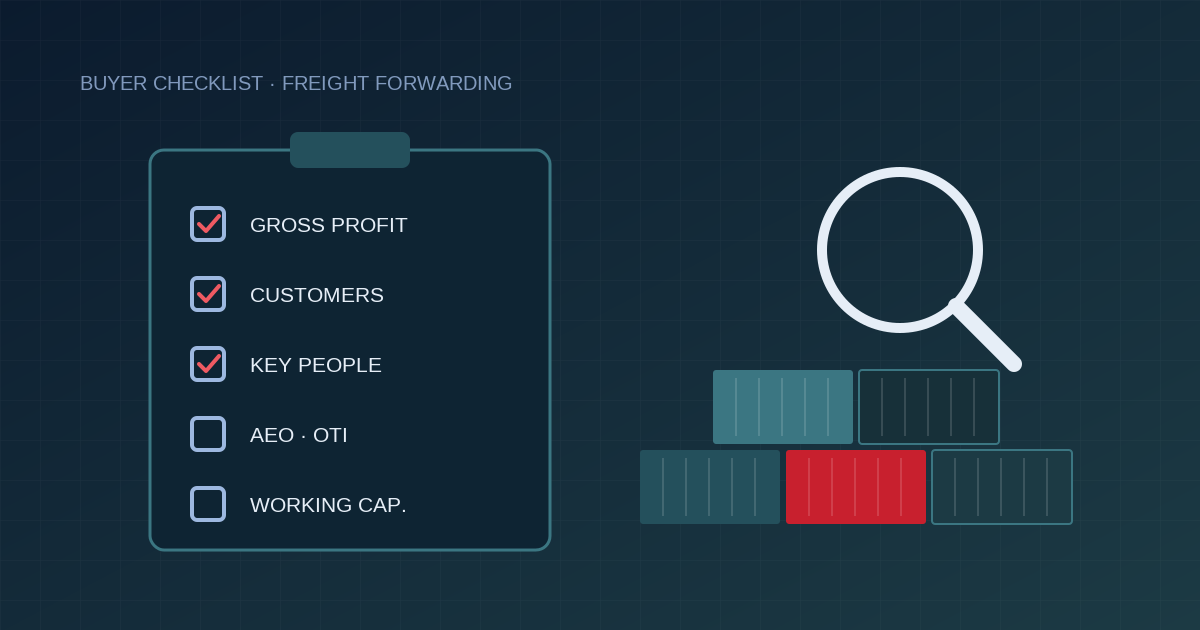
A buyer's checklist for a freight forwarder: gross profit, customer and lane spread, key people, AEO and US OTI licences, working capital and systems.
Key points
- Value a forwarder on gross profit and normalised EBITDA. Turnover is mostly freight paid straight on to carriers.
- Customer and trade-lane concentration, and the people who hold the relationships, are the main risks to test.
- AEO status, customs authorisations and any US OTI licence belong to a specific company. The deal structure decides what you have to file or apply for.
- Agree a working-capital target before you sign: forwarders pre-finance freight and duties.
Freight forwarding is one of the most active corners of logistics M&A. Large groups buy regional specialists to add trade lanes, customs know-how or a vertical, and private equity builds platforms from smaller firms. For a buyer, a forwarder can be attractive because it owns few assets. That is also the risk: most of what you pay for is customers, people, data and licences, and each of them can leave or lapse after completion. This checklist sets out what to test before you sign. It applies the steps of our buyer roadmap to forwarding, and is the buyer's side of our guide to what a freight forwarder is worth.
Start from gross profit, not turnover
A forwarder's revenue includes ocean and air freight that it pays straight on to carriers, so two companies with the same turnover can earn very different profit. Ask for the numbers that show the value the business adds:
| Ask for | What it tells you |
|---|---|
| Gross profit by customer, mode and month, for at least three years | Where the profit comes from, and how steady it is |
| Gross profit per employee | Productivity and the quality of the team |
| Normalised EBITDA | The basis for the price |
| Conversion ratio (EBITDA / gross profit) | Cost discipline; strong forwarders convert 25 to 40 percent |
| Debtor and creditor days | How much cash the business ties up in freight and duties |
Test the normalisation. Exceptional freight rates, such as those of 2021 and 2022, are rarely accepted as normal profit. Owner salaries above or below market, one-off legal costs and rent for property the owner keeps should each be explained.
What drives the price
Small and mid-sized forwarders usually change hands at a multiple of normalised EBITDA. Exitport's valuation tool uses an indicative range of 4x to 7x for freight forwarding and 3.5x to 5.5x for pure customs brokerage. Niches such as project cargo, pharma, perishables or e-commerce, or a strong position on a specific trade lane, can justify the upper end. Concentration, key-person risk and weak data point to the lower end, or to part of the price being paid later. Our guide to earn-outs and seller financing explains how deferred payments bridge a gap.
Customers, trade lanes and carriers
- Concentration: If the top three customers bring more than half of gross profit, expect to price that risk, for example through an earn-out tied to those accounts.
- Contracts: Check whether key customer contracts exist in writing, their notice periods and any change-of-control clauses. Many forwarding relationships run on quotes and habit rather than long contracts.
- Trade lanes: Look at how profit splits by lane and mode, and how exposed it is to one market or one carrier.
- Carriers and partners: Review carrier contracts, rate agreements and the overseas agents or network partners the business relies on, and whether they continue under a new owner.
The people who hold the relationships
In forwarding, sales relationships often sit with a few individuals. Find out who manages the largest accounts, how long they have been with the company and what their contracts say. Retention agreements for key staff and a second line of management reduce the risk that customers follow a salesperson out of the door. Until the seller agrees, do not contact staff, customers or partners: the NDA you signed protects them, and our guide to confidential sales shows why sellers care.
Licences and customs authorisations
AEO certification, NVOCC registrations and IATA accreditation make a forwarder more valuable, but they may need attention on a change of ownership. Ask for a list of every licence, authorisation and membership with its holder, reference and expiry or review date.
- AEO and customs authorisations (EU): Under the Union Customs Code they are granted to a specific legal entity. In a share deal they stay with the company, but the holder must inform customs of relevant changes and customs may check that the criteria are still met. In an asset deal you usually have to apply in your own name, which often takes several months. See AEO status when a logistics company is sold.
- US OTI licence: If the target holds a Federal Maritime Commission licence as an NVOCC or ocean freight forwarder, transfer of a corporate licence needs prior approval, and an acquisition of control must be reported within 30 days on an amended Form FMC-18. Check the qualifying individual and the bond. See FMC rules on change of ownership.
- Guarantees: Check any guarantees lodged with customs and their change-of-control conditions.
- Other approvals: Dangerous goods approvals, IATA or FIATA memberships and warehouse permits belong in the same list.
The structure often decides what survives. Our guide to share deals and asset deals compares the two.
Working capital, debt and the completion price
The price you agree is usually an enterprise value. From it, net debt is deducted and working capital is adjusted against a normal level. Forwarders pre-finance freight and duties, so a business with long customer payment terms and short carrier terms needs a carefully agreed working-capital target. Without one, a good headline price can shrink, or grow, at completion. Our enterprise to equity value calculator shows how the bridge works, and the acquisition loan calculator helps if you plan to borrow.
Systems and data
A modern transport management system, clean shipment data and digital customer access make integration easier. Ask which systems the business uses and under which licences, whether shipment and margin data can be exported, and how customer and employee personal data is handled. Under the GDPR and UK GDPR, expect detailed personal data only at the final stage of due diligence.
Buyer checklist
| Area | Check before you sign |
|---|---|
| Figures | Three years of monthly gross profit by customer and mode; normalised EBITDA with each adjustment explained |
| Customers | Share of gross profit from the top three; written contracts, notice periods, change-of-control clauses |
| People | Who holds the largest accounts; retention agreements; second line of management |
| Licences | AEO and customs authorisations, guarantees, any US OTI licence, IATA and dangerous goods approvals |
| Cash | Debtor and creditor days; working-capital target; net debt at completion |
| Systems | TMS and IT licences, data exports, data protection |
Questions
How should I value a freight forwarder I want to buy?
Start from gross profit and normalised EBITDA, not turnover, because most freight revenue is paid straight on to carriers. Exitport's valuation tool uses an indicative range of 4x to 7x normalised EBITDA for freight forwarding and 3.5x to 5.5x for pure customs brokerage. Customer spread, niches, people, licences and systems decide where a business lands.
What are the biggest risks when buying a forwarder?
Customer and trade-lane concentration, and sales relationships that sit with a few individuals. If the top three customers bring more than half of gross profit, a lower price or an earn-out is common. Retention agreements and a second line of management reduce the people risk.
Does the AEO status stay with the company after a sale?
Customs authorisations, including AEO, are granted to a specific legal entity. In a share deal they stay with the company, but the holder must inform customs of relevant changes and customs may review whether the criteria are still met. In an asset deal the buyer usually has to apply in its own name, which often takes several months.
What if the forwarder holds a US OTI licence?
Under 46 CFR 515.20, transfer of a corporate licence needs the Federal Maritime Commission's prior approval, and an acquisition of control by merger or purchase must be reported within 30 days on an amended Form FMC-18. Also check the qualifying individual and the financial responsibility bond.
Why does working capital matter so much in a forwarder deal?
Forwarders pre-finance freight and duties, so long customer payment terms and short carrier terms tie up cash. The agreed price is usually an enterprise value, from which net debt is deducted and working capital is adjusted against a normal level. Agree the working-capital target carefully, or a good headline price can shrink at completion.
Ready to look? Browse freight forwarders for sale, read the buyer questions in our FAQ, or set up a free deal alert.
This article is general information for business owners and buyers. It is not legal, tax or investment advice. Exitport is an advertising platform and does not act as a broker or adviser.